
Büyük Hamam in Lefkoşa: a historic Turkish bath in Northern Cyprus
Büyük Hamam is a functioning historic Turkish bath in the old part of Lefkoşa, inside the Venetian walls. It is neither a museum nor a modern SPA in a historic interior: the hamam is still used for its original purpose. Medieval stone elements, an Ottoman layout with cool, warm and hot zones, seven domes and a central heated marble platform have been preserved here.
In 2026, Büyük Hamam is open daily from 09:00 to 22:00. The main programs cost from 40 EUR to 80 EUR and last from 50 to 70 minutes. But the most important thing here is not only the treatments: a visit allows you to see how the public bath of Lefkoşa was arranged several centuries ago and why the hamam was an important part of city life.
- History of Büyük Hamam
- What has survived from the medieval building
- How the Ottoman hamam appeared
- Why the hamam was important for women
- How Büyük Hamam is arranged
- Why the entrance is below street level
- Büyük Hamam today
- How a visit takes place
- Prices in 2026
- Address, opening hours and booking
- What to see nearby
- Glossary
- Frequently asked questions
Northern Cyprus has preserved many monuments from different eras, but Büyük Hamam stands out because its history continues not only in its architecture. The traditional bath rooms are still in operation, and visitors follow practically the same route from the cool zone to the hot one that was established when the hamam was created several centuries ago.
History of Büyük Hamam
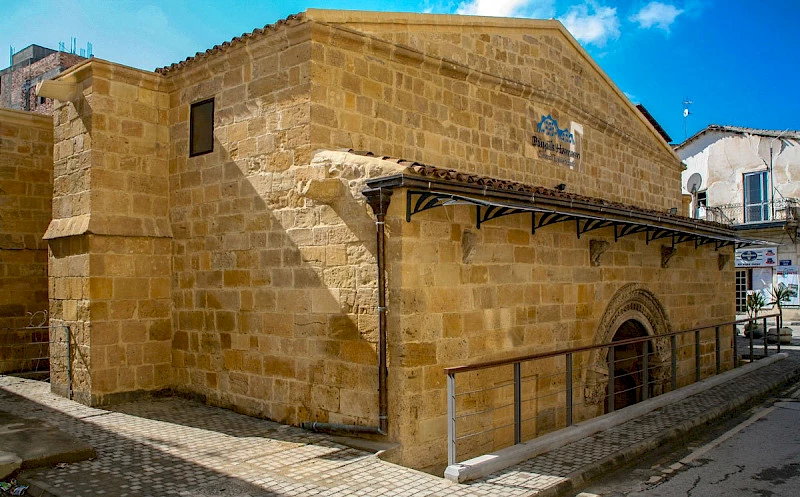
The history of the site began before the hamam itself. Parts of an earlier medieval structure have been preserved in the architecture of the building. Carved stone elements of a Gothic character are especially noticeable at the main entrance; they date from the period before the Turkish bath appeared here.
Older descriptions often associated the structure with the Latin Church of Saint George, built at the beginning of the 14th century. However, a more cautious approach is to speak specifically of a medieval building: the surviving architecture confirms the existence of an earlier Gothic structure, but the exact identification of all its parts remains a subject of research.
This is an important detail for understanding Büyük Hamam. What we see is not a building erected from scratch in the 16th century, but an architectural complex that developed gradually. Later builders did not destroy all traces of the past, but incorporated part of the old stone structure into the new hamam.
What has survived from the medieval building
The most visible medieval elements are located at the entrance. The stone portal differs from the more functional Ottoman architecture of the hamam itself and immediately shows that the building went through several historical stages.
Elements of the earlier structure have also survived inside, including massive stone masonry and large window openings in the changing area. At the end of the 19th century, during work in the hot section of the hamam, a medieval gravestone was discovered beneath one of the marble slabs. It was transferred to a museum.
Such discoveries show how literally different eras were layered on top of one another here: the stones and architectural details of the medieval structure continued to be used inside the Ottoman public bath.
How the Ottoman hamam appeared
At the end of the 16th century, the building was converted into a public Turkish hamam. This process is dated to the period between 1571 and 1590.
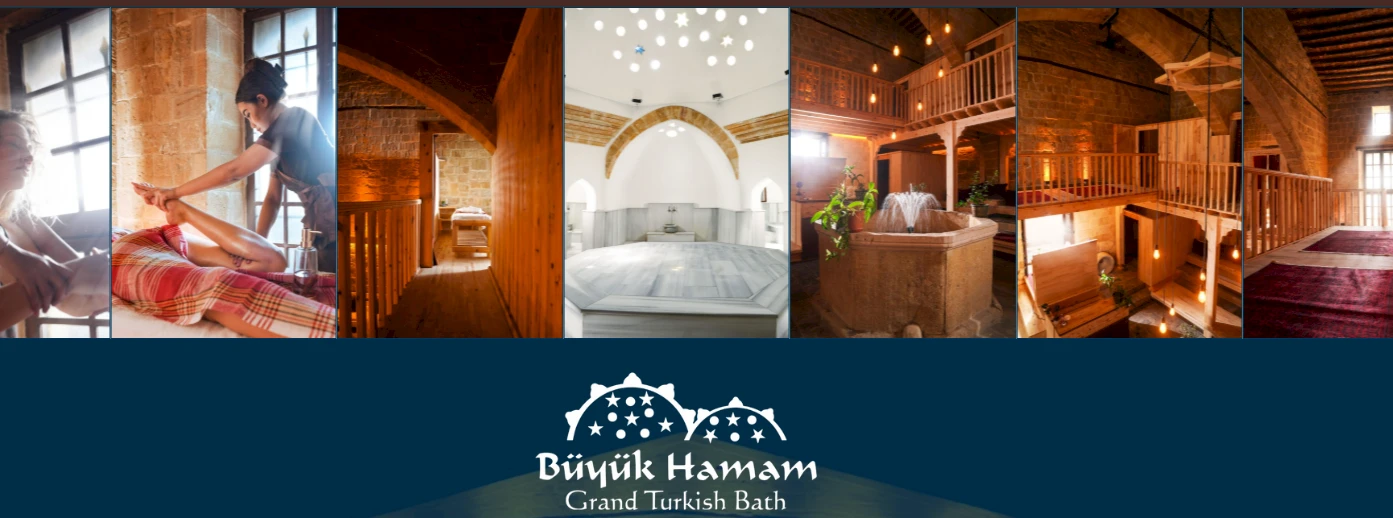
After the reconstruction, the traditional structure of the bath took shape: rooms with different temperatures, domed ceilings, water basins, a hot section and a central marble platform for warming up. Historical descriptions refer to Büyük Hamam as a seven-domed complex.
The hamam belonged to waqf property and was leased to private operators for management. Documents from the end of the 16th century have survived, showing that the bath was already a functioning commercial property that generated income at that time.
This helps explain that Büyük Hamam was neither a palace structure nor a place intended only for privileged residents. It was part of the urban infrastructure—as necessary an institution as a market, fountain or inn.
Why the hamam was important for women
In an Ottoman city, the hamam served several functions at once. It provided an opportunity to wash regularly and use hot water, but at the same time it was a public space where people met, talked and spent time.
Public baths played a particularly noticeable role in women’s lives. Historical descriptions of Büyük Hamam explicitly indicate that women came here not only for bathing treatments. They socialized, exchanged news and organized shared meals here.
For women whose daily lives largely took place within the family and their own neighborhood, the hamam became one of the few regular public spaces. A bathing day could take several hours: women came with relatives, neighbors and friends, bringing towels, personal-care items and food.
Visiting the hamam was also associated with important family events. In the Ottoman bathing tradition, special visits took place before weddings, after the birth of a child and on other family occasions. The hamam was therefore simultaneously a place of hygiene, social interaction and ritual life.
It is precisely this social context that makes Büyük Hamam especially interesting. Today, visitors see not merely beautiful domes and old marble, but a space where ordinary urban life unfolded for generations.
How Büyük Hamam is arranged
A classical hamam is built not around one hot room, but around a gradual transition from coolness to warmth. This system allowed the body to adapt to the temperature and created a sequence for the bathing ritual.
Soğukluk — the cool zone
This is the first part of the hamam. Visitors changed clothes here, left their belongings, rested before treatments and returned after the hot zone. The temperature here is noticeably lower than in the central rooms.
Ilıklık — the warm zone
An intermediate room between the changing area and the hot section. It allowed the body to gradually prepare for a higher temperature and was also used for some bathing treatments.
Sıcaklık — the hot section
The main room of the hamam. It has a large dome, heat is conducted to the floor and walls, and in the center there is a Göbek Taşı—a heated marble platform on which visitors warm up before skin cleansing and the foam massage.
Along the perimeter of the hot section are kurna—stone or marble basins. Warm and cool water is collected in them, mixed to the desired temperature and poured over the body using metal bowls.
The domes contain small glazed openings. They let natural light inside while preserving the privacy and warmth of the room. On a sunny day, light passes through them in separate rays and moves across the stone and marble together with the sun.
It is precisely these architectural details that make a visit to Büyük Hamam noticeably different from an ordinary modern SPA. Here, the structure of the building itself determines the order of the treatments.
Why the entrance is below street level
One of the most unusual details of Büyük Hamam is visible even before entering: the door is located approximately 2 meters below the modern street, and some interior rooms are even deeper.
The building has not sunk into the ground. Over several centuries, the level of the surrounding urban area gradually rose—new street surfaces, construction layers and later development appeared. The historic entrance, however, remained at its original level.
That is why visitors today have to descend stairs to reach the hamam. This change in level clearly shows the age of old Lefkoşa: the modern city literally formed above part of the medieval and Ottoman development.
Büyük Hamam today
In 2007–2008, the hamam underwent extensive restoration. The work was aimed at preserving the historic architecture and the original features of the bathing complex.
The building was later closed again for restoration, after which it resumed operation as a functioning Turkish bath.
Today, Büyük Hamam remains a rare example of a historic site in Northern Cyprus where the building’s original function has been preserved. There is no need to imagine how the hot room, marble basins or central platform were once used: they are still in use.
At the same time, the format has become more modern. In addition to the classic bathing ritual, various types of massage and additional treatments are offered, but the foundation of the visit remains the traditional sequence of warming, cleansing and foam massage.
How a visit to Büyük Hamam takes place
How it works
- After arriving, the visitor changes in a separate area and receives a peştemal—a traditional cotton towel.
- They then pass through the warm zone into the sıcaklık—the hot section of the hamam.
- The body gradually warms up on the Göbek Taşı.
- After warming up, a kese treatment is performed—skin cleansing with a special fabric mitt.
- The next stage is the traditional foam ritual with a large amount of soapy foam.
- After the treatments, the visitor returns to the cooler area and rests.
A classic hamam differs from a sauna in that the key element here is not the maximum temperature, but the combination of heat, water, humidity and gradual warming.
No special knowledge is required for a first visit: the staff explains the procedure. A peştemal is provided on site, and if desired, a simple swimsuit can be worn underneath.
Prices at Büyük Hamam in 2026
As of September 6, 2026, three main programs are available. Prices are listed per person.
| Program | Price | Duration | Main treatments |
|---|---|---|---|
| Pir-u Pak | 40 EUR | 50 minutes | Warming, kese, foam ritual, mask and a drink after the treatment |
| Keyf-i Hamam | 60 EUR | 60 minutes | Extended bathing ritual, body care, foam massage and additional treatments |
| Sultan | 80 EUR | 70 minutes | Extended program with a private Halvet room and longer treatments |
Individual massages are also available in addition to the main packages. Prices start at 40 EUR for 30 minutes.
Before visiting, the current contents of the selected program can be checked on the Büyük Hamam website, as the selection of additional treatments may change.
Address, opening hours and booking
- Name: Büyük Hamam.
- Address: İrfan Bey Sokak 9, Lefkoşa 99010.
- Area: İplik Pazarı, old Lefkoşa.
- Opening hours: daily from 09:00 to 22:00.
- Phone: +90 533 886 02 06.
- Website: buyukhamam.com.
- Location
It is advisable to arrange a booking in advance, especially for visits on weekends or as a couple. A booking request by itself is not considered confirmation, so it is worth waiting for a response from the hamam.
What to see nearby
Büyük Hamam is located in the very historic center of Lefkoşa, so it is convenient to include it in a longer walking tour of the old city. Most of the main attractions are located a short distance from one another.
Nearby are Büyük Han, Bedesten, Selimiye Mosque, the old Bandabuliya market, Kumarcılar Han and the shopping streets of Arasta. A detailed route is provided in the article «The old city in Lefkoşa: what to see inside the Venetian walls».
A visit to the hamam goes especially well with Büyük Han. The caravanserai was built in 1572, meaning that it dates from approximately the same period of urban transformation during which the Ottoman Büyük Hamam was taking shape.
No direct connection between the two buildings has been established, but together they clearly show how everyday life in old Lefkoşa was organized: the han received travelers and merchants, while the hamam served the city’s residents.
If you would also like to see other historic sites, you can use the selection of museums of Northern Cyprus and the article about Christian churches in Northern Cyprus.
For a guided walk, you can look at excursions on Tripster or Sputnik8. If you are planning an independent trip around Northern Cyprus, car rental options are available on Localrent.
Glossary
- Hamam — a traditional public bath with a gradual transition through rooms of different temperatures.
- Soğukluk — the cool entrance section of the hamam for changing and resting.
- Ilıklık — the intermediate warm zone.
- Sıcaklık — the main hot section of the hamam.
- Göbek Taşı — the heated central marble platform in the hot zone.
- Kurna — a stone or marble water basin.
- Kese — a special fabric mitt for cleansing the skin after warming up.
- Peştemal — a thin cotton towel used during a visit to the hamam.
- Halvet — a separate private room for bathing treatments.
- Evkaf — a system for managing waqf property and funds.
Frequently asked questions
Where is Büyük Hamam located in Northern Cyprus?
Büyük Hamam is located in old Lefkoşa, inside the Venetian walls, in the İplik Pazarı area. The current address is İrfan Bey Sokak 9, Lefkoşa 99010.
Is Büyük Hamam really old?
Yes. Elements of a medieval structure have been preserved in the building, while the complex took shape as a public Turkish hamam at the end of the 16th century.
Was there a church here before?
Gothic elements of an earlier medieval building have survived at the entrance and inside. It is traditionally associated with the Latin Church of Saint George, although the exact architectural identification of the original structure is not considered entirely indisputable.
Why does the article not include the story about Peter I?
Episodes linking the medieval building with events of the 14th century appear in some historical retellings, but they do not help explain the history of the hamam itself and depend on the disputed identification of the earlier structure. Therefore, the article includes only facts directly related to the architecture and development of Büyük Hamam.
Is it true that women gathered in the hamam to socialize?
Yes. During the Ottoman period, public baths were an important social space for women. Descriptions of Büyük Hamam mention meetings, the exchange of news and shared meals.
Why is the entrance to the hamam below street level?
Over several centuries, the level of the surrounding streets rose. The historic entrance remained at a lower level, so visitors have to descend to it today.
How many domes does Büyük Hamam have?
The complex is described as a seven-domed hamam. The domes cover different rooms of the bath and help preserve warmth and natural lighting.
Is Büyük Hamam open in 2026?
Yes. As of September 6, 2026, the hamam is open daily from 09:00 to 22:00.
How much does a visit cost?
The main programs cost 40 EUR, 60 EUR and 80 EUR per person. Their duration ranges from 50 to 70 minutes.
Can couples visit?
Yes. The hamam accepts couples and small groups. It is best to confirm the booking in advance for the selected time.
Do I need to bring a towel?
A peştemal is provided on site. If desired, a simple swimsuit can be worn underneath.
What is especially worth seeing inside?
Pay attention to the Gothic stone decoration at the entrance, the change in level between the street and the historic part of the building, the domed ceilings, the openings for natural light, the kurna basins and the central Göbek Taşı.
Is it worth going to Büyük Hamam if I am not interested in SPA?
Yes, if you are interested in the history of old Lefkoşa. The main value of this place lies not in the SPA format, but in the opportunity to see and use a functioning historic hamam whose architecture developed over several centuries.
Author

I am a person who is not afraid to change life when my heart tells me that something greater lies ahead. I am originally from Belarus. I have journeyed from pedagogical and economic education to the financial sector and many years of work in logistics — a world where everything moves, changes,…
You may also be interested in:
- Lefke: the history of the town and what sustains it today
- Traces of British Cyprus: What Has Survived in the Northern Part of the Island
- The Old Town of Lefkoşa: What to See Inside the Venetian Walls
- Eco-Hotels and Wooden Cabins on the Karpaz Peninsula: A Nature-Filled Getaway in Northern Cyprus
- Esentepe Halk Plajı Municipal Beach

Comments (0)