
Karmi: a British village in Northern Cyprus
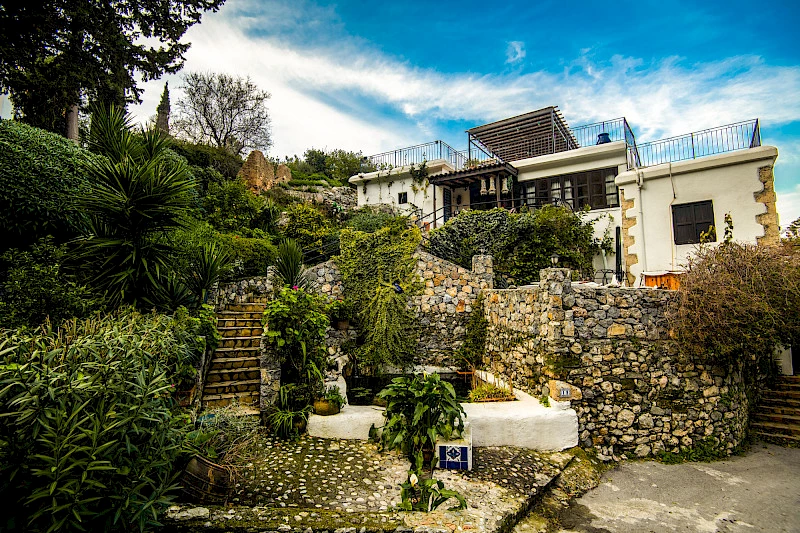
Karmi, or Karaman (Karmi, Karaman), — is a small mountain village above Kyrenia that looks completely different from most settlements in Northern Cyprus. Here, narrow cobbled streets run between stone and whitewashed houses, bougainvillea hangs over the gates, the houses have names of their own, and instead of active modern development, the atmosphere of an old Mediterranean village has been preserved.
Today, Karmi is often called a «British village». But behind the neat facades and gardens lies a much more interesting history — from Bronze Age necropolises to an unusual project to restore an almost deserted village with the help of foreign residents.
- Where is Karmi located
- What makes the village interesting
- The history of Karmi
- Karmi during the Bronze Age
- How an abandoned village was brought back to life
- Why Karmi has preserved its old appearance
- The church in the centre of Karmi
- What to see during a walk
- Where to eat and have coffee
- Special property rules in Karmi
- How to get there
- Frequently asked questions
Where is Karmi located
Karmi is located on the northern slope of the Kyrenia Range, approximately 8 km west of central Kyrenia. The village’s current official name is Karaman (Karaman), although the historical name Karmi is still widely used by local residents, foreigners, tourism resources and businesses in the village itself.
The settlement is located at an altitude of approximately 300–330 metres above sea level. On one side, it offers views towards the Mediterranean Sea and the coast, while on the other, the Kyrenia Range rises above the village. The famous St Hilarion Castle is located practically directly above Karmi.
The altitude is noticeable in summer too: it is usually more pleasant to walk here than on the hot coast. And in just a few minutes by car, you can descend to the lively areas of Kyrenia.
What makes the village interesting
Karmi is worth visiting not for one particular attraction. The village itself is what makes it interesting.
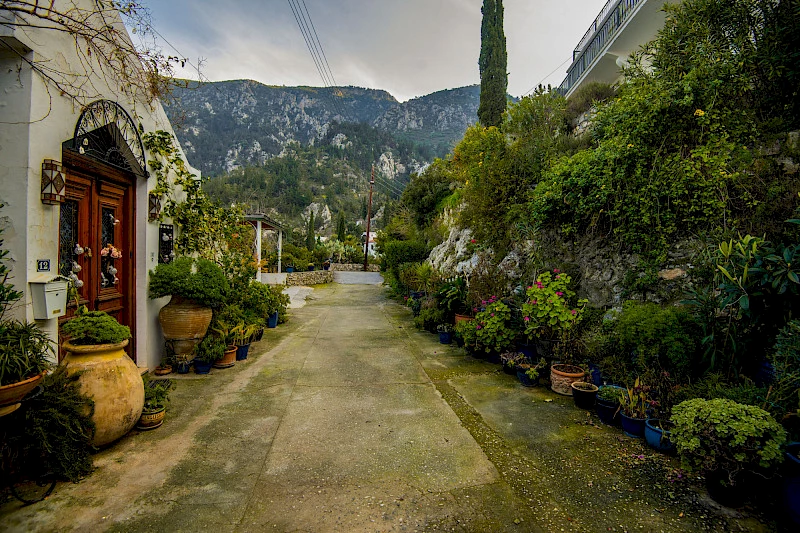
It is pleasant simply to walk without a route: turn into narrow lanes, look at the old houses, small inner courtyards, wooden doors, flowering gardens and signs bearing the names of the houses.
There is practically no sense of a modern resort district in Karmi. The narrow streets of the historic part are not designed for intensive car traffic, and the architecture looks remarkably cohesive.
It is especially beautiful here in spring, when the village is literally immersed in flowers. In summer, bright bougainvillea contrasts with the white walls of the houses, while in autumn and winter Karmi becomes much quieter and resembles a small European mountain village.
At the same time, Karmi’s almost «postcard-perfect» appearance today did not emerge by chance. It was the result of one of the most unusual projects to preserve an old village in Northern Cyprus.
The history of Karmi
The history of this area is considerably older than that of the modern village itself. The area around Karmi was inhabited as early as the Bronze Age, as evidenced by the ancient necropolises discovered here.
Later, a small Cypriot village developed on the mountain slope. Its location was both an advantage and a problem: magnificent views, water and a cooler climate were combined with difficult access to the coast and cities.
By the middle of the 20th century, remote mountain villages gradually began to lose population. Work and economic life became increasingly concentrated on the coast, while daily trips from Karmi, at a time when not every family owned a car, were inconvenient.
After the events of 1974, the village became completely deserted. Many houses were left without residents and quickly fell into disrepair.
Within a few years, Karmi could have turned into ruins. However, the opposite happened.
Karmi during the Bronze Age
Two important archaeological sites are located in the vicinity of the modern village — the Karmi Palealona and Karmi Lapatsa necropolises.
In 1961, Australian archaeologist James Rivers Barrington Stewart, one of the notable researchers of Cyprus’s Early Bronze Age, carried out excavations here.
Archaeologists discovered dozens of burial structures and a large number of objects dating from the Early and Middle Bronze Ages. The finds included hundreds of ceramic vessels, metal objects, figurines and human remains.
Objects testifying to links between the inhabitants of Cyprus’s northern coast and other areas of the Eastern Mediterranean are particularly interesting. Objects associated with the Minoan culture of Crete were found in the burials.
This makes it possible to view the Karmi area not as an isolated mountain settlement, but as part of a territory that thousands of years ago lay close to important maritime trade routes.
How an abandoned village was brought back to life
Karmi’s modern history begins in the late 1970s.
A foreign resident of the village, Nadia Brunton, played an important role in it. According to the history of Karmi’s restoration project, she was concerned about the condition of the old Church of the Virgin Mary in the centre of the settlement. She appealed to the tourism authorities for help in preserving the church.
After visiting Karmi, representatives of the tourism authority saw the potential not only of the church, but of the entire village.
In 1979, the Council of Ministers decided to implement a project aimed at bringing the settlement back to life while preserving its traditional character.
The idea was unusual: instead of demolishing the old houses and building a new district, the partially ruined buildings were offered to foreigners on the condition that the new residents restore them at their own expense and comply with the established architectural requirements.
The first agreements proved insufficiently attractive for serious investment in the ruined buildings. Later, the terms changed, longer leases were introduced, and management of the project was transferred to the Ministry of Tourism.
At the same time, the infrastructure was restored: roads, water supply, electricity, lighting and other utilities.
Gradually, dozens of abandoned houses were given a new lease of life. A significant proportion of the new residents came from the United Kingdom and Germany. This is why Karmi eventually acquired the unofficial name «British village».
Why Karmi has preserved its old appearance
The main feature of the Karmi project was that the houses could not be restored just any way.
Renovation had to conform to the traditional appearance of the village. Features typical of old Cypriot houses were used — wooden beams, traditional ceilings and materials that were visually compatible with the historic buildings.
Even elements that practically no one notices in other villages were regulated. For example, equipment on the roofs was not allowed to spoil the overall appearance. The project’s historic rules included restrictions on the placement of solar water heaters and tall water tanks.
Renovation projects were also not allowed to significantly obstruct the views from neighbouring houses.
Thanks to this, Karmi avoided one of the main problems of the popular areas around Kyrenia — the chaotic coexistence of old houses and large modern developments.
There is also a much more charming feature: many houses in Karmi have names of their own. The names can be seen on small plaques by the entrances. This tradition has become part of the village’s distinctive appearance.
The church in the centre of Karmi
A small old Greek Orthodox Church of the Virgin Mary stands on a small central square.
The church is important not only as a historic building. The story of its preservation effectively became the starting point for the major Karmi restoration project.
Today, the former church is used as a small museum where you can see icons and objects connected with the village’s religious heritage. This is not a large museum in the usual sense, but rather part of Karmi’s preserved historic environment.
Even if the museum is closed during your visit, the square and church are worth including in your walk — they form the natural centre of the old village.
What to see during a walk
Karmi does not require a complicated route. The historic part is so compact that it is best explored on foot and without rushing.
You can start at the central square and church, then walk along the narrow streets between the old houses. Some lanes end with unexpected views of the sea, while others lead to small gardens and terraces.
Pay attention to the details: old doors, stonework, house names, small decorative elements and plants in the courtyards. It is these little things that create Karmi’s atmosphere.
Another reason to come here is the views. From the elevated position, you can see the coast, while looking in the opposite direction, the slopes of the Kyrenia Range and the area around St Hilarion Castle seem to hang directly over the village.
Allow approximately one to two hours for an unhurried walk around the village itself. If you add lunch or coffee, it is easy to spend half a day here.
Where to eat and have coffee in Karmi
Small cafés, a pub and restaurants are part of Karmi’s atmosphere. There is no long restaurant street here: the establishments are literally integrated into the old village, so some of them resemble someone’s cosy home or a small collection of old things.
Cafe Corner
Cafe Corner — is a small atmospheric café in the centre of Karmi. Places like this suit the character of the village well: a small interior, a veranda, unusual décor and a relaxed atmosphere.
You can stop here for coffee, homemade pastries or a refreshing drink during your walk. Visitors’ reviews particularly often mention the homemade desserts, lemonade and unusual café décor.
The Crow's Nest
The Crow's Nest — is a village pub that has served as one of Karmi’s meeting places for many years. It is not simply a tourist establishment, but part of local social life.
While Cafe Corner is better suited to a daytime coffee stop, the Crow's Nest lets you see another side of Karmi — a small community of regular residents for whom the village is home rather than a tourist attraction.
Levant
Levant — is a restaurant near the central part of the village. Its history is also connected with Karmi’s modern life: publications about the village describe Levant as one of the projects that helped shape a new public centre for the settlement.
Before travelling, it is worth checking the current opening hours of your chosen establishment. Karmi is a small village, so the opening hours of cafés and restaurants may change depending on the season.
Special property rules in Karmi
The historic part of Karmi has an unusual property management system for Northern Cyprus. As part of the village restoration project that began in the late 1970s, abandoned houses were provided primarily to foreigners on long-term leases, on the condition that they be restored and their traditional architectural appearance preserved. Over time, the terms of such agreements were extended to as much as 49 years, which is why many old houses in central Karmi are held as leasehold rather than as ordinary freehold ownership with a freehold title. Since the 1980s, compliance with the requirements established for the historic village has been overseen by a special Village Committee.
However, these features should not be applied to the entire modern territory of Karaman/Karmi: the status of each property, the type of title or lease agreement and the possibility of making alterations to the building must be checked separately. Information about a mandatory «interview» between a prospective owner and the village committee appears in accounts of Karmi, but no confirmation could be found that this is an official mandatory rule today.
How to get to Karmi
Karmi is located west of Kyrenia, on the slopes of the Kyrenia Range. The most convenient way to get here is by car.
From the coastal road, you need to drive up towards Karaman/Karmi. The final section runs uphill, so the distance on the map may seem short, but the journey takes longer than a typical drive along the coast.
A car is practically unnecessary inside the historic part. Moreover, many of the streets are very narrow. It is more convenient to leave the car in an accessible parking area and then explore
Views of Kyrenia and the coast
The village offers good views of the sea, coast and mountain slopes. In terms of atmosphere, Karmi is often compared to a viewing platform, except that instead of one viewpoint, the entire village works as one. For panoramic views, you can also see our selection of the best viewpoints in Northern Cyprus.
Route to St Hilarion Castle
Karmi is convenient to combine with a trip to the castle. In addition to the road access, a popular hiking route to the fortress starts here. It usually takes around 3 hours, so it is better to choose a cooler time of day and wear comfortable shoes. If you are interested in such outings, our selection of hiking routes in Northern Cyprus may also be useful.
How to do it
- Build a route to the car park.
- Drive uphill from the Kyrenia side along the mountain road towards St Hilarion.
- Leave the car in the central square by the old church if there are free spaces.
- Continue exploring the village on foot: the streets are narrow, and the walk itself is short and comfortable.
If you are planning a trip without your own car, see our article «Car rental in Northern Cyprus — where to get a car, prices, companies and tips».
Useful services
For a trip to Karmi, you will most often need transport, connectivity and basic travel insurance.
- If you plan to travel around the island by car, you can compare rental options here: Localrent.
- If you need internet while travelling through an eSIM without a subscription fee, you can check the terms offered by Drimsim.
- If you need insurance for a trip or a longer stay abroad, you can choose a policy through Tripinsurance.
Frequently asked questions
Why is Karmi called a British village?
Because of its architectural environment, its historically established community of residents and the village’s overall visual image. Karmi has long been associated with a British lifestyle in Northern Cyprus.
How much time is needed to visit Karmi?
For a short walk, 1–2 hours is usually enough. If you combine Karmi with St Hilarion Castle, cafés and photo stops, it is better to allow half a day for the trip.
Can you visit Karmi without a car?
There is no direct public transport here, so in practice the most convenient options are travelling by car or taxi.
Is there parking in Karmi?
Yes, the main free car park is by the church on the central square. On weekends and during the cooler season, there are usually fewer free spaces.
Is Karmi suitable for a walk with children?
Yes, if you take the terrain into account. The village is small, but some streets are steep, with steps and inclines, so a pushchair will not be convenient everywhere.
Can Karmi and St Hilarion be combined in one trip?
Yes, this is one of the most logical routes in the Kyrenia area. Many people first walk around Karmi and then go up to the castle, or do it in the opposite order.
Author

I am a person who is not afraid to change life when my heart tells me that something greater lies ahead. I am originally from Belarus. I have journeyed from pedagogical and economic education to the financial sector and many years of work in logistics — a world where everything moves, changes,…
You may also be interested in:
- Lefke: the history of the town and what sustains it today
- Traces of British Cyprus: What Has Survived in the Northern Part of the Island
- The Old Town of Lefkoşa: What to See Inside the Venetian Walls
- Eco-Hotels and Wooden Cabins on the Karpaz Peninsula: A Nature-Filled Getaway in Northern Cyprus
- Esentepe Halk Plajı Municipal Beach

Comments (0)