
Antiphonitis Church in Northern Cyprus
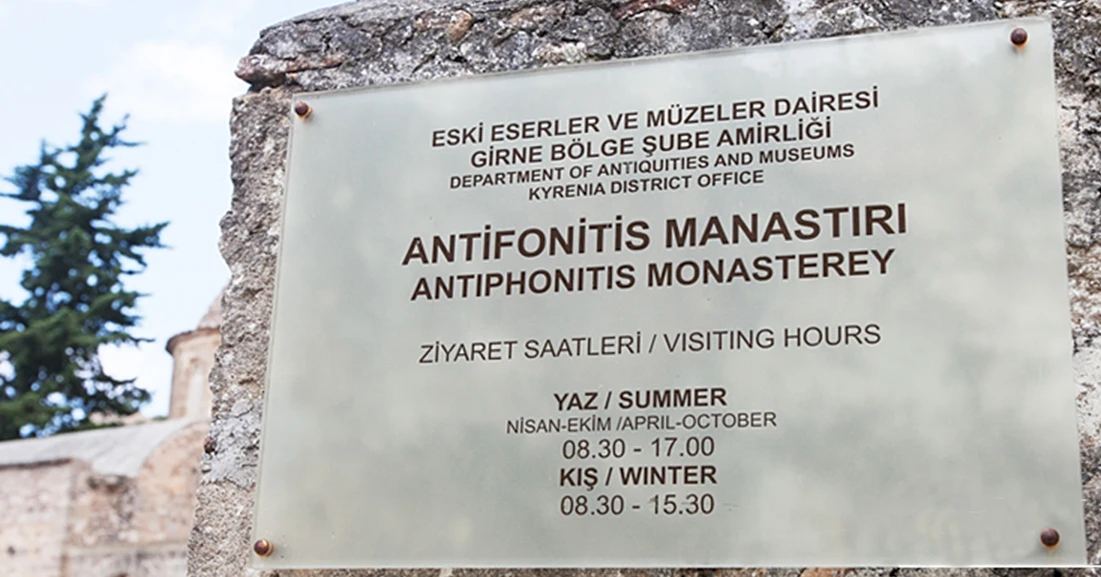
Christ Antiphonitis Church is located in the mountains near the village of Bahçeli in Northern Cyprus. It is a former monastery church with an eight-column dome and frescoes dating from the 12th–15th centuries. According to the sign on the grounds, visiting hours are: April to October — 08:30–17:00, November to March — 08:30–15:30. It is possible to get there by car, although entry inside is not always available even during the stated hours.
- Description of the church
- Origin of the name
- The legend of Antiphonitis
- History of the monastery
- Architecture of the church
- The frescoes of Antiphonitis
- The church today
- Visiting hours
- How to get there
- What to see nearby
- Frequently asked questions

Description of Antiphonitis Church
Christ Antiphonitis Church, in Greek Χριστός Ἀντιφωνητής, is located on the northern slopes of the mountain range, not far from Bahçeli. The church stands at an elevation of about 350 m above sea level, in a small wooded valley away from the coast and main roads.
Today, the monastery complex consists primarily of the church itself, part of a stone enclosure, an arched gallery and several utility rooms. The site is used as a museum, and the church is not permanently active.
The main features of Antiphonitis are the unusual construction of its dome, supported by eight columns, and the surviving wall paintings from different periods. Inside, visitors can also see old pilgrims' inscriptions left on the lower sections of the walls and frescoes.
Origin of the name
The name «Antiphonitis» comes from the Greek word Αντιφωνητής. It is translated as «the one who answers», «the one who echoes» or «the one who answers prayers». The name is also associated with the image of Christ Pantocrator — the Almighty.
The monastery is located in an enclosed mountain valley where echoes can be heard clearly. One theory is that the name may have been connected precisely with the acoustics of the place, where spoken words seem to receive an answer.
The legend of Antiphonitis
A legend about a Constantinopolitan shipowner named Theodore is associated with the name of the church. According to the legend, after being ruined, he turned to a moneylender for a loan but could not find a guarantor. Theodore then proposed that an icon of Christ located in the church be considered the witness.
When he addressed the image, an echo rang out in the church, which those present perceived as an answer. Later, when a dispute arose over the repayment of the money, Theodore again addressed the icon, and the echo, according to the legend, confirmed his words. After this, the moneylender admitted to the deception.
This story belongs to religious tradition and is not confirmed by historical documents, but it is traditionally used to explain the name Antiphonitis — «The One Who Answers».
History of the Antiphonitis Monastery
According to the commonly accepted version, the first church was built here in the 7th century beside a natural spring. At the end of the 12th century, the church became the centre of a monastic complex and was substantially rebuilt.
Over the following centuries, the building's architecture changed repeatedly. A narthex with a barrel vault was added on the western side, while a gallery with five pointed arches on slender columns appeared on the southern side. The gallery's original wooden roof has not survived to the present day.
During the reign of the Lusignan dynasty, the monastery was associated with influential families of the island. Historical sources mention burials of members of the Lusignan family and construction works carried out with their participation.
During the Ottoman period, the church retained its original purpose, but most of the monastic buildings gradually fell into ruin. In 1906, the site came into the possession of Kykkos Monastery.
After 1974, some of the wall paintings were removed and sold outside the island. Some fragments were later discovered and returned to museum collections, but a significant part of the decoration was lost or damaged.
Architecture of the church
Antiphonitis Church belongs to a rare type of domed church. Its central dome rests not on four but on eight columns arranged in a circle. Thanks to this construction, the interior appears more open and unified.
Antiphonitis is considered the only fully preserved example of an eight-column domed church on the island. Some similar architectural features can be found in other monuments in the region, but they have not survived in the same form.
The dome has an irregular oval shape. It is believed that this may have been connected with damage caused by the earthquake of 1222 or with subsequent reconstructions. The drum of the dome contains 12 pointed windows with openwork grilles.
The southern gallery with pointed arches belongs to a later stage of construction. It gives the exterior of the building features characteristic of the medieval architecture of the Lusignan period.
The frescoes of Antiphonitis
The interior walls of the church are covered with paintings from different periods. The earliest frescoes date from the end of the 12th century and are associated with the style of the Late Komnenian period. Other images appeared in the 14th–15th centuries and contain elements of Byzantine and Italian iconography.
Christ Pantocrator
In the central part of the dome there is an image of Christ Pantocrator holding the Gospel in his left hand. He is surrounded by angels, while images of the apostles are located below, between the windows of the drum.
Our Lady of Blachernae
Above the altar area, an image of the praying Virgin of Blachernae with the Archangels Michael and Gabriel has survived. The painting is badly damaged, and the figures' faces are only partially distinguishable.
Other surviving scenes
Fragments of scenes depicting the Baptism of Christ and the Nativity of the Virgin, as well as images of Saint Anthony the Great, Romanos the Melodist, the healer saints Cosmas and Damian, archangels and other saints, can be seen on the walls and columns.
Traces of the compositions «The Last Judgment» and «The Tree of Jesse» have survived on the northern and southern walls. Some of these frescoes were removed from the walls and taken away, so damaged areas of plaster can now be seen in their place.
Inscriptions left by pilgrims from the 18th–20th centuries can be found on the lower parts of the walls. Most are in Greek, but there are also records made in Ottoman Turkish script.
Antiphonitis Church today
Today, Antiphonitis is a museum and archaeological site. Regular services are not held here, but the church retains its religious and cultural significance.
It is cool inside the church even in summer, and thanks to the design of the dome and the stone walls, echoes can be heard clearly here. Occasionally, approved church or choral events take place inside.
A sweetgum tree, also known as an amber tree, grows at the entrance. Its aromatic resin was traditionally used to make incense.
Tables and benches have been installed on the grounds, while the northern side offers views of the mountain slopes, the coast and the surrounding area of Esentepe. In clear weather, the coastal part of Northern Cyprus can be seen from here.
Visiting hours
The information sign at the entrance states the following schedule:
- April to October: 08:30–17:00;
- November to March: 08:30–15:30.
Even during the stated hours, the church may be closed, so entry inside is not guaranteed. However, the exterior of the church and the monastery grounds can usually be viewed from outside.
How to get to Antiphonitis Church
The church is located in the mountains near the village of Bahçeli, between Kyrenia and the Karpas Peninsula. Public transport does not run directly to the monastery, so a car or taxi is required for the trip.
The final stretch passes along a narrow, winding mountain road. In some places, it is difficult for two cars to pass each other, so driving requires caution. There is a small asphalt car park in front of the entrance to the monastery.
Location
How to do it
- Plan to travel by car: dolmuses do not run to the church.
- Save the location on the map in advance, as mobile coverage in the mountains may be unstable.
- Allow extra time for the narrow mountain road.
- Arrive in the first half of the day if you want to increase the likelihood of getting inside.
- Bring comfortable shoes and water, especially during the warm season.
What to see nearby
Along the mountain road towards Kyrenia there is the old, disused Apati Church. The ruins of an abandoned Armenian monastery are also located in the same area.
A trip to Antiphonitis can be combined with a visit to Esentepe, the Bahçeli coast or a drive along the mountain roads. Before travelling, it is worth bearing in mind that the distances between individual sites may be considerable.
Frequently asked questions
Where is Antiphonitis Church located?
It is located in the mountains near the village of Bahçeli, east of Kyrenia in Northern Cyprus.
Can you get there by public transport?
No. Dolmuses do not run directly to the church. A car or taxi is required for the trip.
When is Antiphonitis open?
According to the sign on the grounds, from April to October the site is open from 08:30 to 17:00, and from November to March — from 08:30 to 15:30.
Why may the church be closed during opening hours?
Access inside depends on the presence of a caretaker and the current operating schedule of the museum site. Therefore, entry is not always possible even during the stated hours.
Is the church active?
No. Regular services are not held here. Antiphonitis is used as a museum and archaeological site.
What makes the church's architecture particularly interesting?
The church's dome rests on eight columns. This is a rare design, and Antiphonitis is considered the only fully preserved church of this type on the island.
Which frescoes can be seen inside?
Images of Christ Pantocrator, the Virgin Mary, archangels and apostles, scenes of the Baptism of Christ and other paintings from the 12th–15th centuries have survived.
What does the name «Antiphonitis» mean?
The name is translated as «the one who answers» or «the one who echoes». It is associated with the image of Christ Pantocrator and with the echo that can be heard clearly in the mountain valley.
Is there a car park?
Yes. There is a small asphalt car park in front of the western entrance to the site.
Author

I am a person who is not afraid to change life when my heart tells me that something greater lies ahead. I am originally from Belarus. I have journeyed from pedagogical and economic education to the financial sector and many years of work in logistics — a world where everything moves, changes,…
You may also be interested in:
- Lefke: the history of the town and what sustains it today
- Traces of British Cyprus: What Has Survived in the Northern Part of the Island
- The Old Town of Lefkoşa: What to See Inside the Venetian Walls
- Eco-Hotels and Wooden Cabins on the Karpaz Peninsula: A Nature-Filled Getaway in Northern Cyprus
- Esentepe Halk Plajı Municipal Beach

Comments (0)